How to Know if You Are Ready to Buy a Business
Key takeaways
- Readiness is about your money, skills, support at home and time, not a feeling.
- Keep a personal cash reserve that is separate from the money you put into the deal.
- Write your buying criteria and build your advisor team before you look at listings.
Many people ask whether they are ready to buy a business. The honest answer is that readiness is not a feeling. It is a set of conditions you can check. This guide walks through five of them. If you can answer yes to most, you are likely in a good position to start looking. If not, you now know what to work on first.
What "ready" means
Being ready does not mean you have no fear. Most first time buyers feel nervous. Ready means you have the money, the skills, the support and the time to buy a company and run it through the hard first year. It also means you know what you are looking for, so you do not chase every listing that looks interesting.
Test 1: Your money
You need two pools of cash. The first is the money that goes into the deal. That usually includes the down payment, which is the part of the price you pay from your own funds. It also includes closing costs, such as legal and accounting fees. The second pool is a personal reserve. This is money you keep to cover your household bills while the business finds its footing.
Buyers often forget the second pool. A new owner may choose to take a smaller salary at first, or the business may need cash for repairs or payroll. If your household depends on the business paying you on day one, you have little room for surprises.
Also look at your credit and your debts. Lenders review both. Some loans require you to sign for the loan personally, which means you are personally liable for the loan if the business cannot pay it. Lender rules change over time, so confirm the current requirements with a lender or advisor before you plan around them.
Test 2: Your skills
You do not need to know the industry already. Many buyers come from corporate roles in other fields. But you do need a few core skills. Can you read a profit and loss statement, which is the summary of revenue and expenses over a period? Can you lead people and have hard conversations? Can you sell, or at least manage the people who sell?
Write down where you are strong and where you are not. A gap is not a reason to stop. It tells you what kind of business fits you, and who you need to hire or keep on staff.
Test 3: Your support at home
Buying a business affects your whole household. The search can take months. The first year of ownership often brings long hours and some stress about money. Talk with your spouse or partner before you start. Agree on how much of your savings you are willing to commit, how long you will search, and what the plan is if the right deal does not appear.
When your family is on board, you make clearer decisions. When they are not, every setback feels bigger.
Test 4: Your time
A search is real work. You will review listings, call brokers, read financial statements and meet sellers. Brokers are the professionals who represent sellers and market their companies. If you have a demanding job, be honest about how many hours a week you can give the search. A slow, steady search is fine. A search you never have time for is not.
Test 5: Your criteria and your team
Ready buyers know what they want. Write simple buying criteria: the industries you will consider, the size of business, the location, and the role you want to play as owner. Criteria save time because they let you say no quickly.
You also need a team. At a minimum, that means a lawyer who handles business purchases, an accountant who can do a quality of earnings review, and a lender or financing advisor. A quality of earnings review is a closer look at the seller's numbers to confirm the profits are real and likely to continue. Line these people up before you find a deal, not after.
A worked example: checking your personal runway
Illustrative only. The numbers below are made up to show the math. They are not a target or a recommendation. Your own figures will be different.
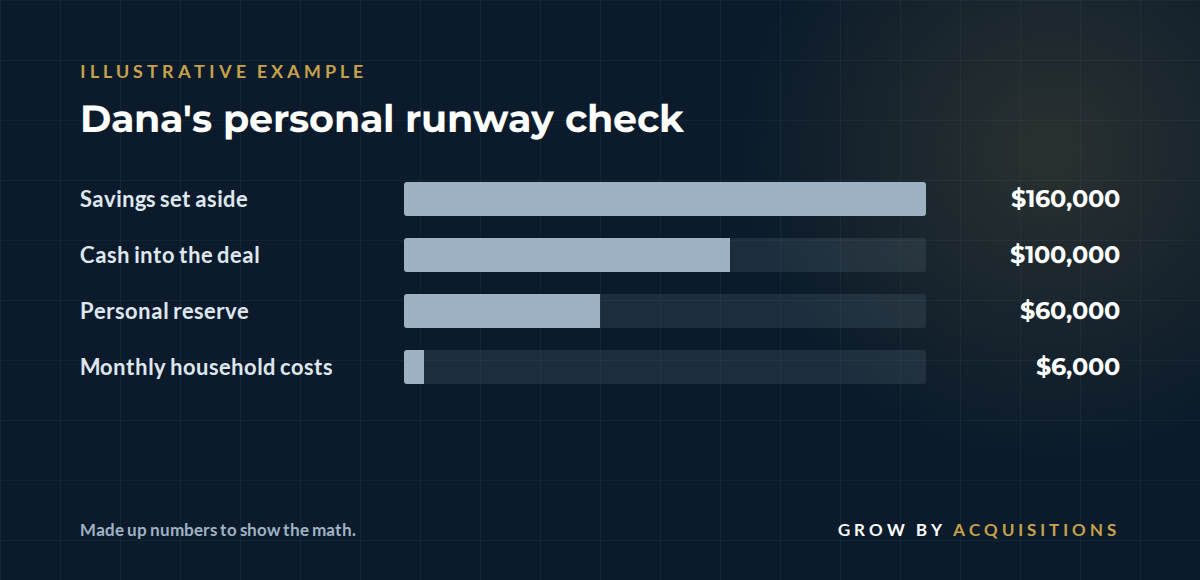
Say a buyer named Dana has $160,000 in savings set aside for a purchase. Dana expects to put $100,000 into the deal for the down payment and closing costs. That leaves $60,000 as a personal reserve.
Dana's household spends $6,000 a month. To find the runway, divide the reserve by the monthly cost: $60,000 divided by $6,000 equals 10. Dana could cover household bills for about 10 months without taking any pay from the business.
Now Dana can ask a better question. Is 10 months enough time for this kind of business to support a salary? If the answer is unclear, Dana could look at smaller deals, build more savings first, or plan for a partner's income to cover part of the bills. The math does not make the decision. It makes the tradeoff visible.
Signs you may need more time
- You would need every dollar you have to close the deal.
- Your household has not agreed on the plan.
- You cannot read a basic set of financial statements yet.
- You have no clear criteria and keep changing what you want.
- You have no time each week to give the search.
None of these rule you out for good. Each one is a task you can work on. Many buyers spend a few months getting ready and then search with much more confidence.
What to do this week
- Add up your savings and your monthly household costs, then work out your own runway using the steps above.
- Write one page of buying criteria covering industry, size, location and the role you want.
- Have one honest conversation at home about time, money and what happens if the search takes longer than planned.
Next step
If you want structure for your search, apply for the Buyer Cohort for $5. You get the 8 day playbook and a complimentary valuation on your first target. Seats are selected by application.
This communication is for informational purposes only and does not constitute an offer to sell or a solicitation of an offer to buy any securities, financial instruments, or investment products. FM Enterprises and Fadi Malouf do not provide legal, tax, investment, or financial advice. Any business, acquisition, or capital related discussion is subject to further review, appropriate due diligence, and applicable professional guidance.
