How Much Cash Do You Need to Buy a Business?
Key takeaways
- Plan for four cash needs, not only the down payment.
- Closing costs and working capital often come out of your pocket before you own anything.
- A seller note or a smaller first deal can lower the cash you need on day one.
Most first time buyers ask one question before any other: how much money do I need to bring? The honest answer is more than the down payment. A purchase has four cash needs, and buyers who plan for only the first one run short in the first year.
This post walks through all four in plain language, then puts them together in one example so you can see the total.
1. The down payment (also called equity injection)
When a bank lends money to buy a business, it wants the buyer to put in some of their own cash. Lenders call this the equity injection. It shows the bank you have something to lose, and it lowers the size of the loan.
Many small business purchases in the United States use an SBA 7(a) loan. That is a loan made by a bank and partly backed by the U.S. Small Business Administration. The SBA and each lender set the rules for how much the buyer must put in, and those rules change. Ask your lender for the current requirement in writing before you make an offer. Do not rely on a number you read online, including in this post.
The down payment does not always have to be all buyer cash. Part of it can sometimes come from a seller note, which is covered below.
2. Closing costs
Closing costs are the bills you pay to get the deal done. They usually include:
- A lawyer to draft and review the purchase agreement.
- An accountant to check the seller's numbers. A deeper review of earnings is often called a quality of earnings report.
- Lender fees, appraisal fees and loan packaging fees.
- Licenses, permits, insurance and any transfer fees.
Some of these can be rolled into the loan. Many cannot, and several are due before you know whether the deal will close. Budget for them as cash you may not get back.
3. Working capital
Working capital is the money the business needs to keep running day to day: paying staff, buying inventory and covering bills while customers take time to pay. A business can be profitable on paper and still run out of cash in its first months under a new owner.
In many deals the seller leaves some working capital in the business, or the lender finances part of it. In others the buyer has to fund it. Find out which early. The purchase agreement should say exactly how much working capital stays with the business at closing.
4. Your personal reserve
This is the one buyers skip. You will likely pay yourself less in the first year than you expect, because the business needs the cash and the lender will want to see the loan paid first. A personal reserve covers your own household bills during that stretch.
A reserve also lets you make calm decisions. A buyer who needs a paycheck next month will cut corners. A buyer with a cushion can fix problems properly.
Putting it together: an illustrative example
Illustrative only. Every number below is made up to show the math. Your lender, lawyer and accountant will give you the real figures for your deal.
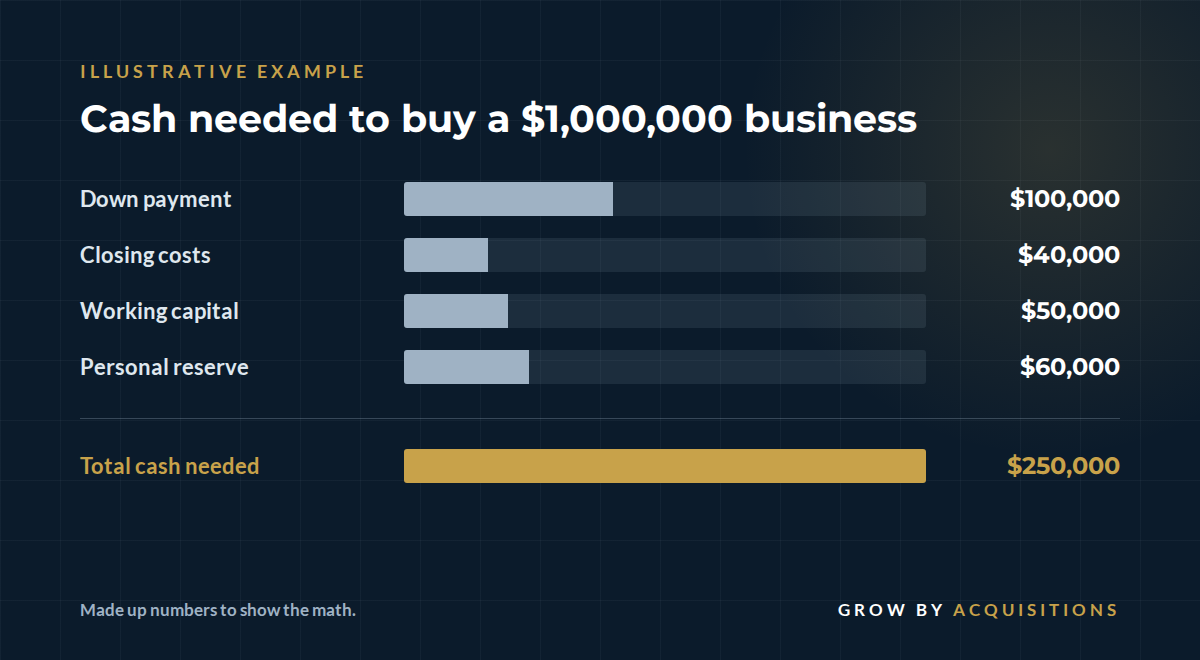
Say you want to buy a service business for a price of $1,000,000.
- Down payment: assume the lender asks for 10 percent. That is $100,000.
- Closing costs: assume legal, accounting and lender fees total $40,000.
- Working capital: assume the business needs $160,000 to run for two months, the lender finances most of it, and you fund $50,000.
- Personal reserve: assume your household needs $10,000 a month and you want six months. That is $60,000.
Add them up: $100,000 plus $40,000 plus $50,000 plus $60,000 equals $250,000.
So in this example, a buyer who planned for only the $100,000 down payment would be $150,000 short. That gap is why deals fall apart late, or why new owners struggle in year one.
Ways buyers reduce the cash they need
A seller note
A seller note means the seller agrees to be paid part of the price over time instead of all at closing. It lowers the cash you need on day one, and it keeps the seller interested in your success. Lenders have rules on how a seller note can count toward the down payment, so ask yours before you build it into an offer.
Partners or investors
Some buyers bring in a partner for part of the down payment. That works, but it changes who owns what and who makes decisions. Put the terms in writing with a lawyer before any money moves.
Buying a smaller business first
Your first business does not have to be your forever business. A smaller first deal teaches you how lending, closing and the first 100 days work, with less of your cash at risk.
What to do this week
- Write down the cash you can put in without touching money your family needs.
- Call one SBA lender and ask three questions: what down payment do you require, what fees should I expect, and do you finance working capital.
- Build your own version of the example above with your numbers.
If the total looks reachable, you are closer to ready than most people who are still browsing listings.
Next step
If you are serious about buying your first business, apply for the Buyer Cohort for $5. You get the 8 day playbook and a complimentary valuation on your first target. Seats are selected by application.
This communication is for informational purposes only and does not constitute an offer to sell or a solicitation of an offer to buy any securities, financial instruments, or investment products. FM Enterprises and Fadi Malouf do not provide legal, tax, investment, or financial advice. Any business, acquisition, or capital related discussion is subject to further review, appropriate due diligence, and applicable professional guidance.
