Why Buyers Pay Less for an Owner Dependent Business
Key takeaways
- Buyers pay for profit that continues after you leave.
- Owner dependence lowers the multiple and makes the deal terms tougher.
- Moving customers, know how and contracts to your team is a fix you control.
Many owners are surprised by their first offer. The business makes good money, customers are loyal, and the number still comes in lower than expected. One of the most common reasons is simple: the business depends on the owner.
This post explains what buyers mean by owner dependence, why it lowers the price, and what you can change before you sell.
What owner dependence means
A business is owner dependent when it would struggle if the owner stopped showing up. Signs include:
- The biggest customers call the owner directly, not the company.
- The owner sets every price and approves every quote.
- Key know how lives in the owner's head, not in written steps.
- Staff wait for the owner to make most decisions.
- The owner holds the main licenses, supplier relationships or bank relationship personally.
None of these mean the business is weak. They mean the business and the owner are hard to separate, and a buyer is only buying the business.
Why buyers lower the price
A buyer pays for the profit the business will make after they own it. If that profit depends on you, the buyer has to ask what happens when you leave. Three things follow.
The buyer sees more risk
If customers might leave with the owner, future profit is less certain. Less certain profit is worth less. Buyers show that by offering a lower multiple. A multiple is the number a buyer multiplies your yearly profit by to reach a price.
The lender sees more risk
Most buyers borrow to buy. A bank looks hard at whether the business can repay the loan without the seller. If it cannot tell, it may lend less, which caps what the buyer can pay.
The deal terms get tougher
Even when the headline price holds, an owner dependent business often gets harder terms. That can mean more of the price paid later instead of at closing, part of the price tied to future results (called an earnout), or a longer period where you stay on to hand things over.
An illustrative example
Illustrative only. These numbers are made up to show the math. Real multiples depend on your industry, size, buyer and market.
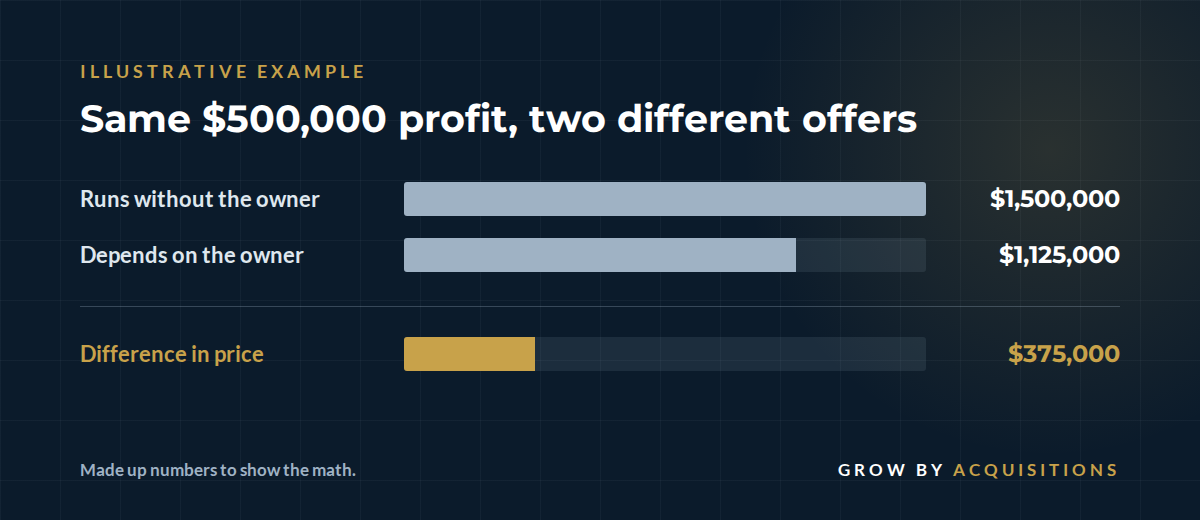
Say your business earns $500,000 a year in seller's discretionary earnings. That is the profit plus what you pay yourself and certain one time or personal costs.
- A buyer who sees a business that runs without the owner might offer 3.0 times earnings: $500,000 times 3.0 equals $1,500,000.
- A buyer who sees heavy owner dependence might offer 2.25 times earnings: $500,000 times 2.25 equals $1,125,000.
Same profit, a $375,000 difference in this example. And the second offer may also come with more of the money paid later.
How to reduce owner dependence
The good news: this is one of the few value drivers you control. Most fixes take months, not years, and they make the business easier to run even if you never sell.
Move customer relationships to the team
Introduce a manager or account lead to your top customers. Let them handle routine calls while you step back. Track which customers now deal mainly with someone other than you.
Write down how the work gets done
Pick the ten tasks only you do today. Write each one as simple steps another person could follow. Then hand them off one at a time and fix the steps when something breaks.
Build a second in command
A buyer feels much better when there is a capable person who can run daily operations. Give that person real decisions, a clear title and a reason to stay after a sale.
Put contracts and licenses in the company's name
Where you can, move supplier agreements, leases, licenses and key accounts from your personal name to the business. Ask a lawyer which ones can transfer and how.
Take a real vacation
Two weeks away with your phone mostly off is a useful test. Whatever breaks while you are gone is your to do list.
How buyers check
Expect a serious buyer to ask who your top customers talk to, who could run the business tomorrow, and what happens if you are sick for a month. They may also speak with key staff. Answers backed by written steps, a named manager and customer records will carry more weight than reassurance.
Start before you plan to sell
Owner dependence is easiest to fix when no buyer is watching. Changes made in the last few months before a sale can look staged, and buyers know it. Changes made a year or more ahead show up in the numbers: customers who renewed without you, a manager who ran a busy season, written steps your staff already use.
It also protects you if you never sell. An owner who can step away for a month can handle an illness, a family need or a new opportunity without the business sliding. Many owners find the business grows once decisions stop waiting on them.
If you do plan to sell in the next few years, track your progress the way a buyer would. Each quarter, note how many top customers now deal mainly with your team, how many key tasks have written steps, and how many days you were out without problems. Those three numbers tell the story a buyer will look for.
What to do this week
- List your top ten customers and note who each one calls first.
- List the decisions that only you make today.
- Pick one task and one customer relationship to hand off this month.
Next step
Want to see how your business looks to a buyer today? Take the advisory quiz. It takes a few minutes and shows where to focus first.
This communication is for informational purposes only and does not constitute an offer to sell or a solicitation of an offer to buy any securities, financial instruments, or investment products. FM Enterprises and Fadi Malouf do not provide legal, tax, investment, or financial advice. Any business, acquisition, or capital related discussion is subject to further review, appropriate due diligence, and applicable professional guidance.
