
What Is My Business Worth? How Buyers Set the Price
By Fadi Malouf, operator since 1999
Key takeaways
- Buyers price the earnings they expect to keep, not your revenue or your effort.
- Clean up your earnings first, because every add back needs a document behind it.
- Expect a range, since the final price depends on risk, terms and the buyer.
Most owners ask what their business is worth at one of two moments: when a buyer calls, or when they start to think about life after the company. The honest answer is that your business does not have one fixed value. It has a range, and a buyer decides where you land in that range based on what they can verify.
This post shows how that range gets built, so you can make a rough estimate before you talk to anyone.
Worth depends on who is asking
A value for an insurance policy, an estate plan and a sale can all be different numbers for the same company. This post covers the sale. A buyer is paying for the cash the business can produce in the future. The past is the evidence they use to judge that future.
That is why your years of effort, your sacrifices and the amount you need for retirement do not set the price. They matter a great deal to you. A buyer will look at the numbers and the risks.
Buyers start with earnings, not revenue
Revenue is your total sales. Earnings are what remains after the costs of running the business. Two companies with the same revenue can have very different earnings, so buyers rarely price a company on sales alone.
You will hear two common measures of earnings:
- Seller's discretionary earnings. This is profit plus the owner's pay and personal benefits. It shows the total cash available to one working owner, and it is often used for smaller, owner run companies.
- EBITDA. This stands for earnings before interest, taxes, depreciation and amortization. In plain terms, it is profit before financing costs, taxes and certain accounting charges. It is often used for larger companies with a management team in place.
Ask your accountant or adviser which measure fits your company. Then use the same one every time you compare numbers.
Clean up your earnings with add backs
Many private companies run their books to keep taxes low, which can make profit look smaller than the cash the business can produce. An add back is an expense on your books that a new owner would not have. You add it back to profit to show normalized earnings, which means earnings as they would look under normal ownership.
Common add backs include personal expenses run through the company, one time costs such as a lawsuit, and owner pay above what a hired manager would earn.
Put each add back through three tests:
- Is it truly personal or truly one time?
- Would a new owner be able to stop paying it?
- Can you show a document that proves it?
If an item fails any test, leave it out. Buyers will check your claims during due diligence, the period when they review your records before closing. A stretched add back can cost you more than its own amount, because it makes the buyer doubt the rest of your numbers.
The multiple is a measure of risk
A multiple is the number a buyer multiplies your earnings by to reach a price. It is not a fixed rule. It reflects how confident the buyer feels that the earnings will continue after you leave.
These factors tend to push the multiple up or down:
- Customer mix. Revenue spread across many customers feels safer than revenue tied to a few.
- Repeat revenue. Contracts and repeat buyers are easier to forecast than work that must be won again each month.
- Earnings trend. Steady or rising earnings are easier to trust than a sudden good year.
- Records. Clean, timely financial statements make a buyer's review faster and raise confidence.
- Team. A company that runs without the owner in every decision carries less risk for the next owner.
Multiples change with the industry, the size of the company and market conditions. Be careful with numbers you find online. Ask a business broker or a merger and acquisition adviser what they are seeing for companies like yours.
A worked example
Illustrative only. The numbers here are made up to show the math. They are not a market figure and they say nothing about what your business would sell for.
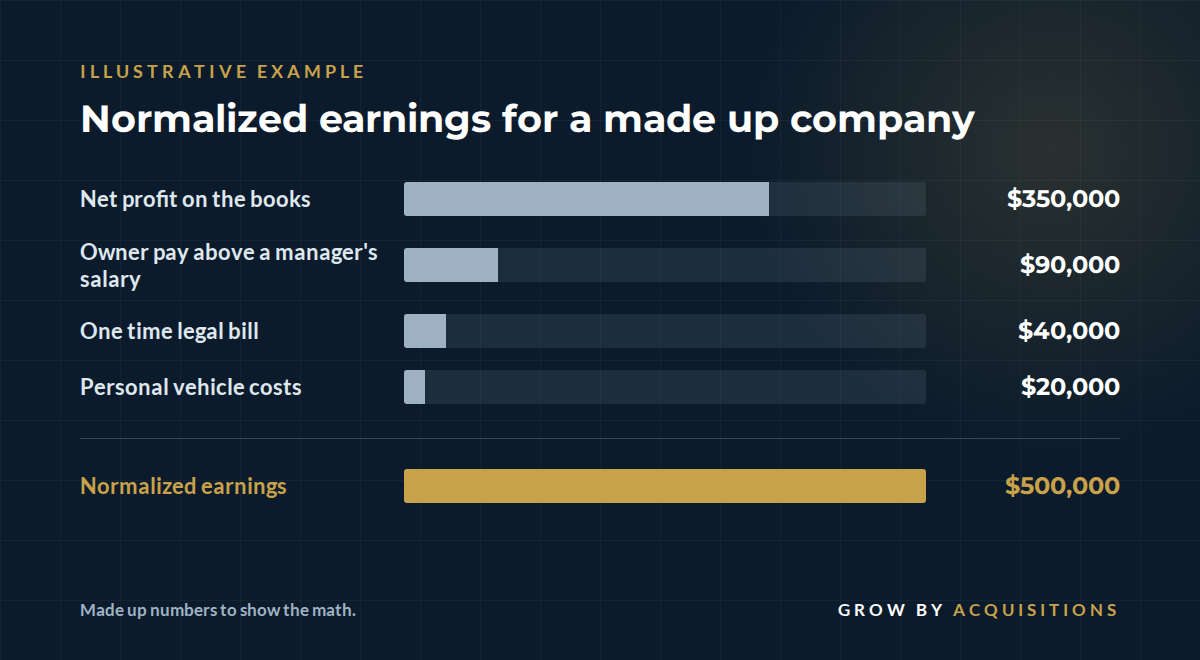
Picture a services company with $3,000,000 in annual revenue. Its books show $350,000 in net profit. The owner reviews the expenses and finds three items that pass all three tests:
- $90,000 of owner pay above what a hired manager would earn
- $40,000 for a one time legal bill
- $20,000 in personal vehicle costs
Add those to profit and the normalized earnings come to $500,000.
Now suppose a buyer in this made up case sees a multiple between 3 and 4. The low end is $500,000 times 3, or $1,500,000. The high end is $500,000 times 4, or $2,000,000. The owner now has a range to discuss, plus a list of the items that could move it.
Price is not what you keep
Two offers with the same headline price can leave you in very different places. Before you compare them, look at how each one is built:
- Cash at closing. This is the money you receive on the day the sale completes.
- Seller note. This is a part of the price that you lend to the buyer and collect over time.
- Earnout. This is a part of the price paid later, and only if the business hits agreed targets.
- Working capital. This is the cash and other short term assets the company needs for daily operations. Buyers usually expect a normal level to stay in the business at closing.
Debt, taxes and deal fees also come out of what you receive. Tax treatment and deal rules change, so confirm your situation with a CPA and an attorney before you rely on any estimate.
Frequently asked questions
What is the difference between a valuation and a price?
A valuation is an estimate of what the business could sell for. A price is what one specific buyer agrees to pay on specific terms.
Do I need a professional valuation before I talk to a buyer?
Not always, but you should know your normalized earnings before that first talk. A formal appraisal, which is a written opinion of value from a credentialed professional, may be needed for tax, legal or partner matters. Ask your adviser if your situation calls for one.
Will a buyer pay for my growth plans?
Buyers mostly pay for results that have already happened and can be verified. Growth that has not happened yet is more often shared through terms such as an earnout.
What to do this week
- Pull your last three years of tax returns and financial statements, and put them in one folder.
- List every possible add back, then run each one through the three tests and attach the proof.
- Write down your largest customers and the share of sales each one represents, then note what you would do if one left.
Next step
If you want a clearer view of where your business stands before you talk to a buyer, take the advisory quiz. It takes a few minutes and shows where to focus first.
About Fadi Malouf
Fadi Malouf has owned and operated companies since 1999 and has run FM Enterprises since 2002. He buys, fixes and funds lower middle market businesses and writes here about how those deals get done.
This communication is for informational purposes only and does not constitute an offer to sell or a solicitation of an offer to buy any securities, financial instruments, or investment products. FM Enterprises and Fadi Malouf do not provide legal, tax, investment, or financial advice. Any business, acquisition, or capital related discussion is subject to further review, appropriate due diligence, and applicable professional guidance.
