What an SBA Lender Looks At When You Buy a Business
By Fadi Malouf, operator since 1999
Key takeaways
- The lender cares most about whether the business cash flow can pay the loan with room to spare.
- Expect the lender to review your experience, your credit history and the cash you put in yourself.
- You will likely sign for the loan personally, so review every term with your own attorney.
You found a business you want to buy, and the price makes sense to you. Now a lender has to agree. If you plan to use an SBA loan, the lender will look at the deal from a few specific angles. If you know those angles before you apply, you save time and can spot a weak deal early.
What an SBA loan is
SBA stands for the U.S. Small Business Administration. In most cases the SBA does not lend you the money. A bank or other approved lender makes the loan, and the SBA backs part of it. That backing lowers the lender's exposure. This is why lenders will finance business purchases they might otherwise turn down.
The program has rules on loan size, terms, fees and how much of your own money goes in. Those rules change over time. Confirm the current version with your lender and your accountant before you build a plan around them.
The five things an SBA lender looks at
1. Cash flow that can carry the debt
This is the center of the file. Cash flow is the money the business produces after its normal costs. The lender wants to see that this cash can cover the yearly loan payments with room left over. The test is called the debt service coverage ratio. Debt service means your total loan payments for the year. The ratio divides the cash available by those payments. A higher number means more cushion.
Lenders usually work from the seller's tax returns, not from a sales summary. If the profit on the returns is lower than the profit in the listing, expect the lender to use the returns.
2. You, the buyer
The lender is betting on you to run the company. It will ask about your work history, your management experience and whether you know the industry or one close to it. It will also review your credit history and your personal finances. A strong background does not replace cash flow, but a weak one can stall a good deal.
3. Your equity injection
Equity injection is the cash you put into the deal yourself. Lenders want you to have real money at stake. They will ask where the money came from and may review months of bank statements to confirm it. Some deals let a seller note count toward this amount. A seller note is a loan from the seller to you, paid back over time. Whether it counts, and how much, depends on current rules and the lender. Ask early.
4. Collateral and personal liability
Collateral is property the lender can claim if the loan is not repaid. The business assets come first, such as equipment, inventory and money owed by customers. If those do not cover the loan, the lender may also take a lien on personal assets, such as equity in your home. A lien is a legal claim on property until a debt is paid. You will likely be asked to sign for the loan personally. That means you are personally liable for the loan if the business cannot pay.
5. The deal itself
The lender reviews the purchase price, the purchase agreement and the transition plan. It may order an independent valuation to check the price. It wants to know how long the seller will stay to train you and whether key customers and staff are likely to stay. A business that leans heavily on its owner raises questions here.
A worked example of the cash flow test
Illustrative only. The numbers below are made up to show the math. They are not typical figures and do not describe any real deal.
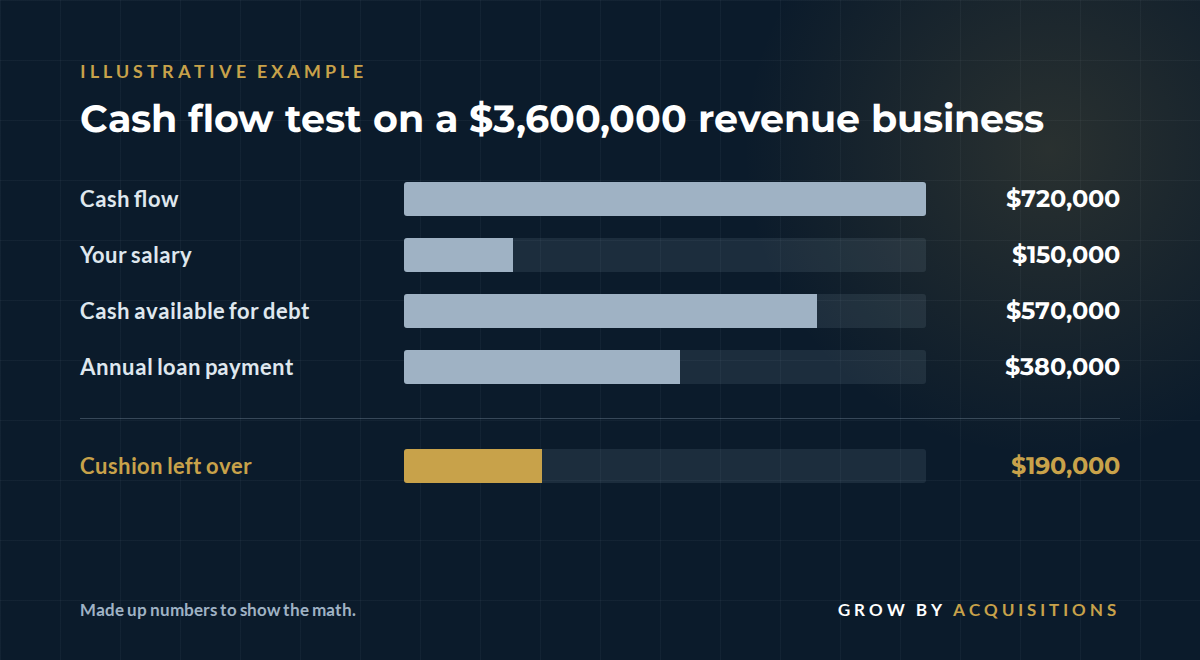
Say you want to buy a commercial cleaning company with $3,600,000 in annual revenue. After normal costs, the business produces $720,000 in yearly cash flow before any loan payments.
The lender will not count all of that as available for debt. You need to be paid to run the company, so the lender subtracts a fair salary for you. Say that salary is $150,000.
- Cash flow: $720,000
- Less your salary: $150,000
- Cash available for debt: $570,000
Now say the proposed loan has yearly payments of $380,000. The coverage ratio is $570,000 divided by $380,000, which equals 1.5. In plain terms, the business produces one and a half dollars of available cash for every dollar of loan payment. The cushion left over is $570,000 minus $380,000, or $190,000.
Each lender sets its own minimum ratio. If your number falls short, the usual levers are a lower price, more of your own cash or a larger seller note. Ask the lender what minimum it uses before you make an offer.
Documents to gather before you apply
- Several years of business tax returns and financial statements from the seller
- A current year to date profit and loss statement and balance sheet
- Your personal tax returns and a personal financial statement
- Proof of the cash you plan to put in and where it came from
- A signed letter of intent, which is a short document that sets out the price and main terms before the final agreement
Frequently asked questions
Do I need experience in the same industry?
Not always. Lenders want to see that you can manage people and money, and related experience helps. If you are switching fields, a strong seller transition plan or an experienced manager who stays on can help close the gap.
Can the seller finance part of the deal?
Often, yes. A seller note can sit alongside the SBA loan, and in some cases it can count toward your cash injection. These rules change, so confirm the current terms with your lender.
How long does SBA approval take?
It varies by lender and by how complete your file is. A clean, organized package moves faster than one where the lender has to chase documents.
What to do this week
- Pull your own credit history and fix any errors you find.
- List the cash you can put in and gather statements that show where it came from.
- Call two SBA lenders and ask which coverage ratio and documents they require.
Next step
Reading about lenders is a start. You learn the most by working a real deal with guidance. If you want a structured way to evaluate your first target and build a package a lender can review, apply for the Buyer Cohort for $5. You get the 8 day playbook and a complimentary valuation on your first target. Seats are selected by application.
About Fadi Malouf
Fadi Malouf has owned and operated companies since 1999 and has run FM Enterprises since 2002. He buys, fixes and funds lower middle market businesses and writes here about how those deals get done.
This communication is for informational purposes only and does not constitute an offer to sell or a solicitation of an offer to buy any securities, financial instruments, or investment products. FM Enterprises and Fadi Malouf do not provide legal, tax, investment, or financial advice. Any business, acquisition, or capital related discussion is subject to further review, appropriate due diligence, and applicable professional guidance.
