
The 3 Things That Move Your Business Valuation Most
By Fadi Malouf, operator since 1999
Key takeaways
- Buyers price a business on earnings they can verify and a multiple that reflects risk.
- Predictable revenue and a wide spread of customers can raise the multiple a buyer will pay.
- A team and written processes help the business keep running after you step back.
If you own a company, you have probably wondered what it would sell for. The honest answer is that it depends on what a buyer sees when they look closely. Many things affect the price, but three of them tend to move it more than the rest. This post walks through each one, shows the math in a simple example, and ends with steps you can take this week.
First, how buyers think about value
Most buyers of a private company start with earnings. Earnings are the profit the business produces in a year. A common measure is EBITDA, which stands for earnings before interest, taxes, depreciation and amortization. In plain terms, it is operating profit before a few accounting and financing items.
The buyer then applies a multiple. A multiple is the number a buyer multiplies earnings by to reach a price. A higher multiple means the buyer sees less risk and more future in the business. A lower multiple means the buyer sees more that could go wrong.
So price comes from two things: how much the business earns, and how much the buyer trusts those earnings to continue. The three drivers below work on one or both of those.
Driver one: earnings a buyer can verify
A buyer pays for profit they can prove, not profit the owner says is there. That proof comes from clean financial statements. These are the records of what the business took in, what it spent and what it owns.
Many owners run personal costs through the company. A family phone plan, a car, or a salary for a relative who does little work are common cases. Buyers may add these back to earnings. An add back is an expense that would not continue under a new owner, so it is added back to show true profit. But a buyer will only accept add backs that are documented. If the records are messy, the buyer either ignores the add back or lowers the multiple to cover the doubt.
What helps here
- Books kept monthly by a bookkeeper or accountant, not caught up once a year.
- Business and personal spending kept in separate accounts.
- A written list of each add back with receipts or invoices behind it.
Driver two: revenue a buyer can predict
Two businesses can earn the same profit and still sell for very different prices. The difference is often how predictable the revenue is. Revenue is the total money customers pay the business before costs.
Recurring revenue comes from customers who pay on a schedule, such as a monthly service contract. Buyers like it because next year looks a lot like this year. Revenue from one time projects is harder to count on, because each sale has to be won again.
Customer concentration matters too. Concentration means a large share of sales comes from a small number of customers. If one of those customers leaves after the sale, the buyer loses a big piece of what they paid for. Buyers price that risk in, often through a lower multiple or by holding back part of the price until the customer stays.
What helps here
- Written contracts with your larger customers, with clear terms and renewal dates.
- A wider spread of customers so no single one can sink the year.
- Records that show how long customers stay and how often they reorder.
Driver three: a business that runs without you
A buyer is buying the future, and the future does not include you behind the counter forever. The question is whether the company keeps working after you step back. We cover owner dependence in a separate post, so here is the short version.
Transferability means how easily the business passes to a new owner and keeps performing. It rests on three things: a team that can make daily decisions, written processes that show how work gets done, and customer and supplier relationships held by the company rather than by one person.
What helps here
- A manager or small leadership team who already runs daily operations.
- Written steps for the core jobs: sales, delivery, billing and hiring.
- Key customers who know and trust people other than the owner.
A worked example
Illustrative only. The numbers below are made up to show the math. They are not a forecast or a market figure. Picture a services company with $4,000,000 in annual revenue.
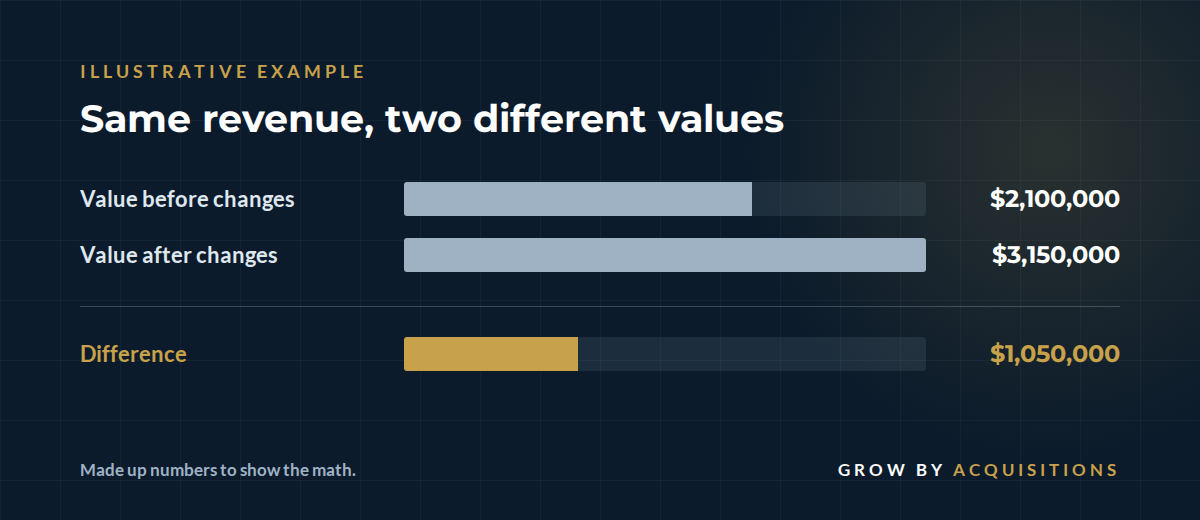
Today the books show $600,000 in EBITDA. The owner runs some personal costs through the company, but nothing is written down. One customer brings in a large share of sales with no contract. A buyer looks at that and offers 3.5 times earnings. That puts the value at $2,100,000.
Now picture the same company after two years of work on the three drivers. The owner moves personal costs off the books and documents them, so verified EBITDA becomes $700,000 on the same $4,000,000 in revenue. The large customer signs a contract that runs for several years, and a general manager runs daily work. A buyer now sees less risk and offers 4.5 times earnings. That puts the value at $3,150,000.
The difference is $1,050,000. Revenue did not change. Part of the gain came from higher verified earnings, and the larger part came from a higher multiple, which reflects lower risk. Real offers depend on the buyer, the industry and the market at the time, so treat this as a picture of how the parts connect, not a prediction.
Frequently asked questions
Which of the three drivers should I work on first?
Start with your financial records, because every buyer and lender will ask for them first. Clean books also make the other two drivers easier to prove.
How long does it take to improve these drivers?
It depends on the business. Cleaning up records can take a few months, while reducing customer concentration or building a team often takes longer. Starting well before you plan to sell gives you more room.
Do personal expenses in my business hurt the price?
They can if they are not documented, because a buyer cannot tell what true profit is. Tax treatment of these costs varies, so confirm your approach with your accountant or tax advisor.
What to do this week
- Ask your bookkeeper for your last three years of financial statements and note any gaps.
- List your top ten customers and the share of sales each one brings in.
- Write down three decisions only you make today and name who could make them instead.
Next step
If you want a clearer view of which driver matters most for your company, take the advisory quiz. It takes a few minutes and shows where to focus first.
About Fadi Malouf
Fadi Malouf has owned and operated companies since 1999 and has run FM Enterprises since 2002. He buys, fixes and funds lower middle market businesses and writes here about how those deals get done.
This communication is for informational purposes only and does not constitute an offer to sell or a solicitation of an offer to buy any securities, financial instruments, or investment products. FM Enterprises and Fadi Malouf do not provide legal, tax, investment, or financial advice. Any business, acquisition, or capital related discussion is subject to further review, appropriate due diligence, and applicable professional guidance.
