
Search Fund or Self Funded Search: Which Fits You?
By Fadi Malouf, operator since 1999
Key takeaways
- A search fund trades ownership for investor support and a salary while you look.
- A self funded search keeps more ownership but puts your savings and credit on the line.
- Test your fit on control, personal risk, time without pay and the support you need.
The short answer
A search fund trades ownership for support. A self funded search trades support for ownership. Neither one is better on its own. The right one depends on how much control you want, how much personal risk you can carry, and how long you can go without a paycheck.
If you are leaving a corporate role to buy your first company, this choice shapes everything that follows. It decides who you answer to, whose money is at stake, and how the deal gets paid for. This guide walks through both paths in plain terms so you can see which one fits your life.
What a search fund is
A search fund is a structure where a group of investors pays you to look for a business. They cover your salary and your search costs while you hunt. When you find a company, those same investors get the first chance to fund the purchase.
In return, the investors own most of the company after closing. You earn your share over time, often in stages tied to milestones such as closing the deal and meeting agreed goals. The exact split is set in the agreement, and it varies from deal to deal.
You also gain a board. A board is a small group, usually your investors, who meet with you on a set schedule and weigh in on big decisions. For many first time buyers, that guidance is the main draw.
What a self funded search is
A self funded search means you pay for the hunt yourself. You use your savings to live on and to cover costs such as legal and accounting work. When you find a business, you raise the money for that one deal.
That money usually comes from three places. A bank loan covers the largest part. A seller note covers some of it. A seller note is when the owner lets you pay part of the price over time, out of the business. Your own cash, and sometimes money from a few outside investors, covers the rest.
You keep far more of the company. You also carry more of the weight. With many small business loans, the buyer must sign for the loan personally. That means your home and savings can be on the line if the business struggles. Lender rules change, so confirm the current terms with a lender and an attorney before you plan around them.
Four tests to find your fit
1. How much control do you want?
With a search fund, you run the company, but your investors hold the majority. They can weigh in on hiring, debt and a future sale. With a self funded search, you make the final call. Think about how you felt answering to a boss in your corporate role. That feeling is a good guide here.
2. How much personal risk can you carry?
Search fund investors take most of the money risk. In a self funded search, your savings pay for the search, and you may be personally liable for the loan. Talk this through with your spouse or partner before you choose. It is a family decision, not only a career one.
3. How long can you go without a salary?
A search can take a long time, and some searches end with no deal. A search fund pays you while you look. A self funded searcher lives on savings. Build a household budget that covers a long search with room to spare.
4. How much support do you need?
Investors in a search fund often bring deal experience, contacts and coaching. Self funded buyers build their own bench. That bench is an attorney, an accountant, a lender and a mentor who has bought a company before. If you have never run a small business, weigh this test heavily.
A worked example: the same deal two ways
Illustrative only. The numbers below are made up to show the math. They do not describe a real deal or predict any result.
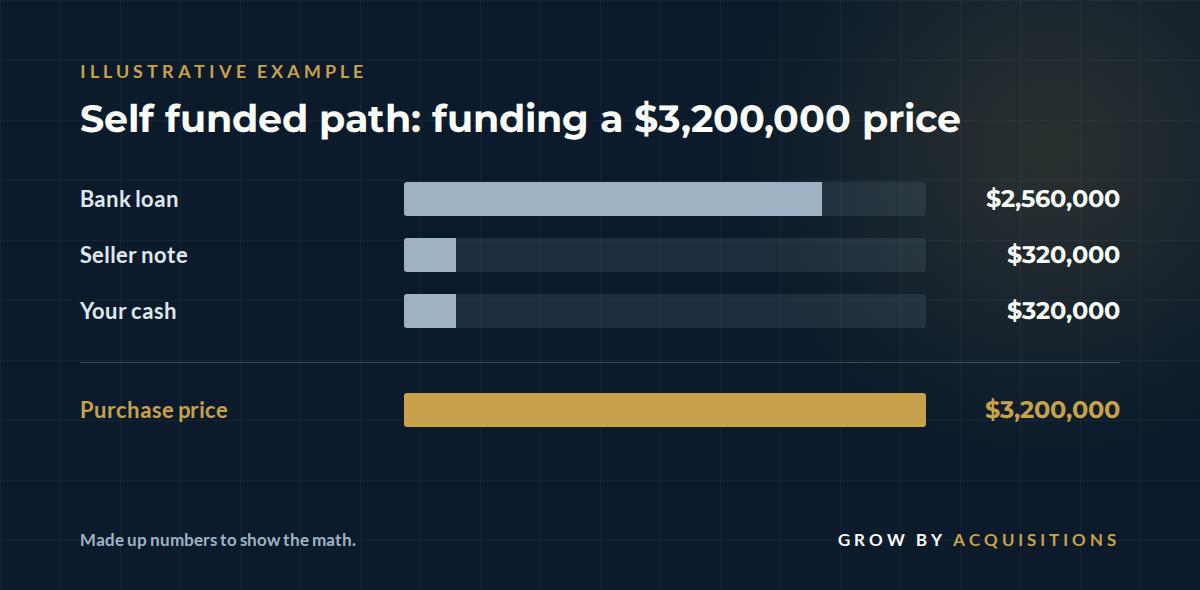
Say you find a business with $4,000,000 in annual revenue. Revenue is the total sales before any costs. The owner agrees to a price of $3,200,000.
Path one: self funded
- Bank loan: $2,560,000
- Seller note: $320,000
- Your cash: $320,000
Add them up: $2,560,000 plus $320,000 plus $320,000 equals $3,200,000. You own the company. You also signed for the bank loan personally, and you spent your own savings during the search.
Path two: search fund
- Bank loan: $2,000,000
- Investor equity: $1,200,000
Add them up: $2,000,000 plus $1,200,000 equals $3,200,000. Equity means money paid in exchange for ownership. Here you put in no cash at closing. The investors own most of the company, and you earn your share over time under the agreement.
Same business, same price. The difference is who put money in, who owns what, and who is on the hook if things go wrong.
What executives often miss
Sellers care about who you are, not only about your structure. Many owners want to know their team and customers will be in good hands. A clear story about why you want their business matters on either path.
Your corporate skills help, but small companies are different. You may be the person who fixes payroll, calls the key customer and signs the checks in the same week. Spend time with owners of small firms before you commit to either path.
You can also blend the two. Some buyers fund the search themselves and then bring in a few investors for the deal. Others raise from a small group and keep more control. Ask an attorney how each structure would work for you.
Frequently asked questions
Do I need an MBA to raise a search fund?
No. Many investors look for operating experience, leadership and a clear plan. Investor groups differ, so ask each one what they look for.
Can I switch paths partway through?
Yes. Some buyers start self funded and bring in investors once they find a deal. Switching can change your ownership and your terms, so get advice before you sign anything.
Who pays if a self funded search finds nothing?
You do. The money you spent on living costs and advisers is gone, which is why a firm budget and a time limit matter before you start.
What to do this week
- Write down how many months your household can go without your salary.
- Score yourself from one to five on each of the four tests above.
- Call one attorney and one lender and ask how each path would work for you.
Next step
Before you choose a path, take the acquisitions quiz. It shows where you stand and what to prepare first.
About Fadi Malouf
Fadi Malouf has owned and operated companies since 1999 and has run FM Enterprises since 2002. He buys, fixes and funds lower middle market businesses and writes here about how those deals get done.
This communication is for informational purposes only and does not constitute an offer to sell or a solicitation of an offer to buy any securities, financial instruments, or investment products. FM Enterprises and Fadi Malouf do not provide legal, tax, investment, or financial advice. Any business, acquisition, or capital related discussion is subject to further review, appropriate due diligence, and applicable professional guidance.
