How to Finance an Add On Acquisition
By Fadi Malouf, operator since 1999
Key takeaways
- Most add on deals combine several sources, such as bank debt, seller financing and platform cash.
- Lenders look at the combined business and whether it can repay the loan in a slow year.
- Run a downside case on the add on's earnings before you sign anything.
You own a company and you have found a smaller one that fits. Maybe it serves the same customers, or it adds a service you do not offer. The next question is money. How do you pay for it without putting your current business under strain?
An add on acquisition is a purchase that joins a smaller company to one you already own. The company you already own is often called the platform. Financing an add on is different from financing a first purchase, because the platform's own track record can help you borrow. This guide walks through the main funding sources, how they fit together, and what lenders look at.
Why an add on is financed differently
When you buy your first company, a lender looks at the target and at you. When you buy an add on, the lender also looks at the platform. If the platform has steady earnings and clean books, it can carry part of the load.
The flip side is that the platform is now on the line too. A deal that strains the platform can hurt the business you already built. So the goal is a structure the combined company can carry in a slow year, not only in a good one.
The main sources of money
Most add on deals use a mix of sources. Each one has a cost and strings attached.
Cash from the platform
The simplest source is cash the platform already holds or produces. There is no lender and no interest. The catch is that cash spent on a deal is cash you no longer have for payroll, equipment or a rough quarter. Keep a cushion.
Senior bank debt
Senior debt is a loan that gets paid back first if things go wrong. It is usually the lowest cost borrowed money. Banks often lend against the combined earnings of the platform and the add on. Many banks ask the owner to sign for the loan personally, which means your own assets can be at stake. Ask about this early.
Government backed loans
In the US, the Small Business Administration backs certain loans made by approved lenders. These programs can allow a smaller down payment, but they come with detailed rules on ownership, seller financing and personal liability. Those rules change. Confirm the current terms with an SBA lender before you build a plan around them.
Seller financing
A seller note is a loan from the seller to you. Instead of taking the full price at closing, the seller takes part of it in payments over time. This lowers the cash you need on day one. It also keeps the seller invested in a smooth handoff, since they want to be paid.
Earnouts
An earnout is part of the price paid later, only if the add on hits agreed targets such as revenue or profit. It helps when you and the seller see the future differently. It can also lead to disputes, so the targets and how they are measured need to be written clearly.
Rollover equity and outside investors
Rollover equity means the seller keeps a slice of ownership instead of cash for that part of the price. Outside investors can also put in equity, which is money in exchange for ownership. Equity has no monthly payments, but you give up a share of future profits and some control.
What lenders look at
A lender wants to know one thing above all. Can the combined business pay the loan back? They test that in a few ways.
- Debt service coverage. This compares the cash the business earns to the loan payments it owes each year. More coverage means more room for a bad year.
- Quality of earnings. This is a review of the target's books to confirm the profit is real and repeatable, not boosted by one time items.
- Your track record. How the platform has performed since you took over, and whether you have merged two businesses before.
- Collateral. Assets the lender can claim if the loan is not repaid, such as equipment, receivables or real estate.
Coverage targets and lending limits vary by lender and change over time. Ask each lender for their current standards in writing.
A worked example
Illustrative only. The numbers below are made up to show the math.
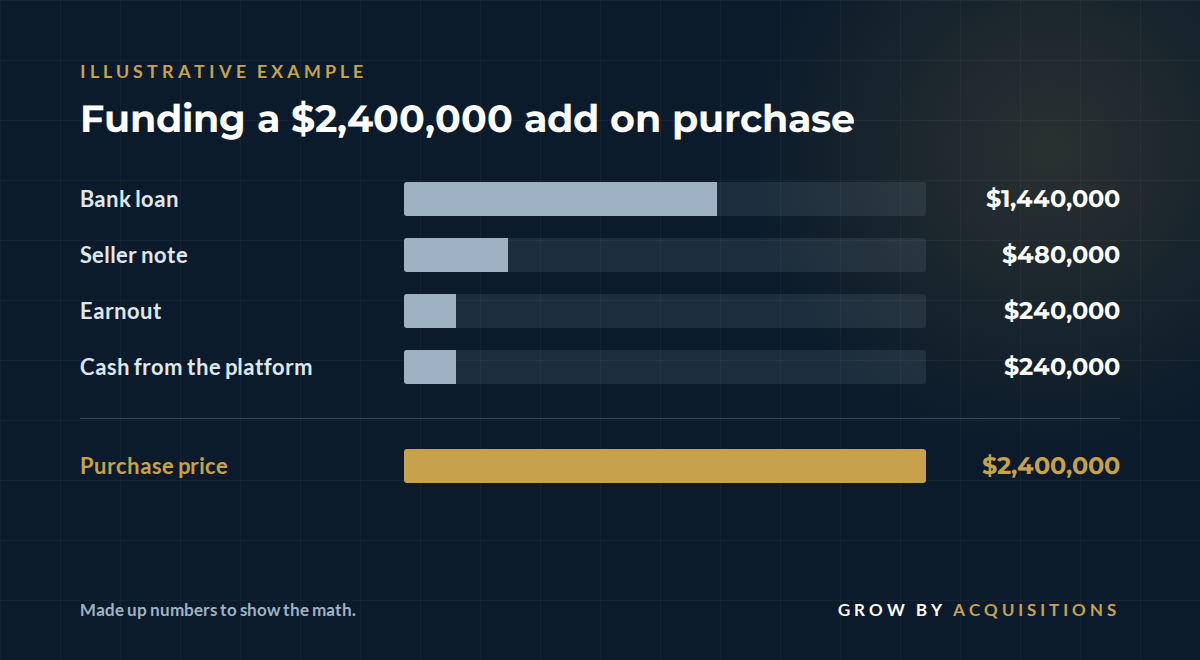
Say you own a platform company and find an add on with $3,200,000 in annual revenue. Its yearly earnings before interest, taxes, depreciation and amortization, called EBITDA, are $640,000. You agree on a price of $2,400,000.
You fund it this way:
- Bank loan: $1,440,000
- Seller note: $480,000
- Earnout, paid later if targets are met: $240,000
- Cash from the platform: $240,000
Add them up and you get $2,400,000, the full price. Now check whether the add on can carry its share. Suppose the bank loan payments come to $230,000 a year and the seller note payments come to $110,000 a year. That is $340,000 a year in debt payments. Against $640,000 in earnings, that leaves $300,000 before taxes, new investment and surprises.
Now run the downside. If the add on's earnings fell to $400,000, the cushion would shrink to $60,000. Testing that case before you sign is the point of the exercise.
Build your deal team early
You will want a lender who knows acquisitions, an accountant to review the target's books, and a deal attorney to draft the purchase agreement and the seller note. Bring them in before you make an offer, so the structure you propose is one you can close.
Frequently asked questions
Can my current business help finance an add on?
Often, yes. Lenders may count the platform's earnings and assets when they size a loan. That also puts the platform at stake, so plan for a slow year.
Will a seller agree to carry a note?
Many sellers will consider it, especially when it helps the deal close. Terms are negotiated case by case, so ask early and put them in writing.
Do I need outside investors for an add on?
Not always. Some add ons close with platform cash, bank debt and seller financing alone. Investors make sense when the deal is larger than what you can borrow or you want to keep more cash in the business.
What to do this week
- Pull the platform's last three years of financials and note how much cash you can spare without strain.
- Call one lender who finances acquisitions and ask what they need to see for an add on.
- Sketch a funding mix for a target you are watching and run a downside case on its earnings.
Next step
If you are weighing your first add on, take the acquisitions quiz. It shows where you stand and what to prepare first.
About Fadi Malouf
Fadi Malouf has owned and operated companies since 1999 and has run FM Enterprises since 2002. He buys, fixes and funds lower middle market businesses and writes here about how those deals get done.
This communication is for informational purposes only and does not constitute an offer to sell or a solicitation of an offer to buy any securities, financial instruments, or investment products. FM Enterprises and Fadi Malouf do not provide legal, tax, investment, or financial advice. Any business, acquisition, or capital related discussion is subject to further review, appropriate due diligence, and applicable professional guidance.
