Buy a Business or Start One? 5 Tests to Decide
By Fadi Malouf, operator since 1999
Key takeaways
- Buying gets you customers, staff and earnings today. Starting means building every piece yourself.
- Executive skills fit best where a business already runs and needs a leader to improve it.
- Due diligence is how a buyer checks that the earnings are real before the sale closes.
You have run teams, budgets and plans for someone else. Now you want something of your own. The first fork in the road is easy to name and hard to answer. Do you buy a company that already works, or do you start one from a blank page?
Both paths can work. They ask for different skills, different kinds of patience and different kinds of risk. This guide walks through the trade offs in plain terms so you can pick the path that fits how you work.
What each path means
Starting a business means you build from zero. You create the product, find the first customers, hire the first people and set up every system. Nothing exists until you make it.
Buying a business means you take over a company that already has customers, staff, suppliers and a record of earnings. You pay the current owner, called the seller, for what has already been built. Your job shifts from creating to running and improving.
Why the choice looks different for an executive
Corporate leaders tend to be strongest at running things. You know how to read a profit and loss statement, the summary of revenue, costs and profit over a period. You know how to manage managers, set targets and fix a process that leaks. Those skills matter most once a business has customers and a team.
A startup leans on a different set of skills in its early years. The founder sells the first deals in person, builds the product with thin resources and lives with long stretches of uncertainty. Some executives love that. Many find they miss the structure they had.
Neither path is better. The point is to be honest about where your strengths sit.
Five tests to help you decide
1. Do you want to create or to improve?
If the idea itself excites you most, starting may fit. If you get energy from taking something that works and making it run better, buying may fit.
2. How long can you go without a paycheck?
A new company can take a long time to pay its founder. An established company already produces cash flow, the money left after the business pays its bills. That cash may cover your salary and any loan payments from the start, though nothing assures it.
3. Where does the risk sit?
With a startup, the main risk is that customers never show up. With a purchase, the main risk is paying too much or buying a problem you did not see. Buyers manage that second risk through due diligence, the detailed check of a company's books, contracts, customers and staff before the sale closes.
4. How will you fund it?
Lenders tend to be more willing to finance a business with a track record of earnings than an idea with none. Buying often involves a loan, and you may need to sign for the loan personally. That means your own assets can be at stake if the business struggles. Lending rules change over time, so confirm current terms with a lender and a qualified advisor.
5. Who will you lead on day one?
A startup gives you a blank org chart. A purchase gives you a team that already has habits, loyalties and worries about the new owner. If you have led people through a merger or a reorganization at work, that experience carries over well.
A worked example with simple math
Illustrative only. The numbers below are made up to show the math. They are not a forecast, a typical deal or a result anyone should expect.
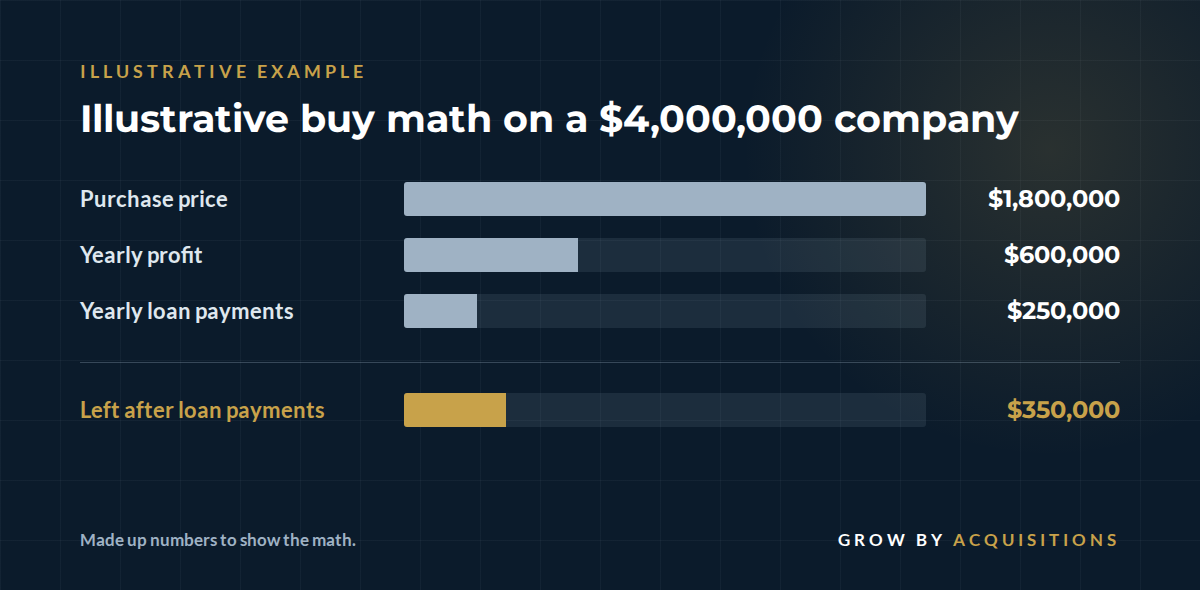
Say you find a services company with $4,000,000 in annual revenue. After all costs, including a fair salary for a general manager, it produces $600,000 a year in profit. The seller asks $1,800,000, which is three times that yearly profit.
You fund most of the price with a loan. In this example, the yearly loan payments come to $250,000. Subtract that from the profit. $600,000 minus $250,000 leaves $350,000 a year before taxes to reinvest, hold as a cushion or pay down the loan faster.
Now compare a startup in the same field. You might spend $500,000 to open the doors and still have no customers on the first day. That money is spent whether or not the business finds its footing.
The math does not say buying wins. It shows what you pay for when you buy: earnings that exist today. Your real work is to confirm those earnings are sound and will hold after the seller leaves.
Common mistakes on each path
- Buyers fall in love with a deal and rush the checks. Slow down and verify.
- Buyers assume staff and customers will stay. Ask how tied they are to the seller.
- Founders underestimate how long it takes to build steady sales.
- Founders spend on polish before they have paying customers.
When starting may still be the better fit
Starting can make sense when no company for sale matches what you want to build, when the market is new, or when you have a clear product idea and a network of likely first customers. It can also suit someone who wants to grow slowly and keep debt low.
Frequently asked questions
Is buying a business less risky than starting one?
Not always. Buying removes the risk of having no customers, but it adds the risk of overpaying or missing a hidden problem. Careful due diligence is how buyers manage that.
Do I need industry experience to buy a business?
It helps, but many buyers lean on general leadership skills and keep key staff who know the trade. Plan for a handover period with the seller so you can learn the details.
Can I keep my job while I look for a business?
Many people search while still employed. Check your employment agreement for limits on outside work before you start talking to sellers.
What to do this week
- Write down which you enjoy more: building from nothing or improving what exists.
- Work out how many months you could cover household costs with no salary.
- Talk with a lender and an accountant about how a purchase would be funded and taxed.
Next step
If buying looks like the better fit, the next move is to see how prepared you are today. The simplest way to do that is to take the acquisitions quiz. It shows where you stand and what to prepare first.
About Fadi Malouf
Fadi Malouf has owned and operated companies since 1999 and has run FM Enterprises since 2002. He buys, fixes and funds lower middle market businesses and writes here about how those deals get done.
This communication is for informational purposes only and does not constitute an offer to sell or a solicitation of an offer to buy any securities, financial instruments, or investment products. FM Enterprises and Fadi Malouf do not provide legal, tax, investment, or financial advice. Any business, acquisition, or capital related discussion is subject to further review, appropriate due diligence, and applicable professional guidance.
